

The perfect prompt doesn'texist. What exists is apipeline with a definitionof done
People who produce AI images at a professional level don't win by writing better prompts. They win by having steps, order and a done criterion. It is the difference between repeated luck and an operation that delivers every week.

The perfect prompt doesn't exist
A pipeline does. And it is what makes the same quality come out on Tuesday and on Friday.
I have wasted an embarrassing amount of time hunting for prompts.
I saved them in a file. I traded them with people who also saved them. I tested variations, changed a word, added “cinematic,” removed “cinematic.” And every now and then something really good came out — and then came the part nobody tells you: the next week, with the same prompt, it came out mediocre.
The conclusion I took a while to accept is simple. A prompt is a roll of loaded dice. It improves your odds, it doesn't guarantee your result. And anything you need to deliver every week can't depend on odds.
What solves it isn't a better prompt. It is a pipeline: steps, order, an owner and a written criterion for when the thing is done.
That sounds bureaucratic until you compare two operations of the same size. One produces in bursts, with quality swinging from great to embarrassing. The other has fewer peaks and no valleys. The second doesn't have a better prompt. It has a process.
I state the method, as in this whole series: we mapped public AI cinema and creative culture blogs to understand how people who live off images organized their work once the machine entered the studio.
The sample is biased on purpose. These are audiovisual people, not Brazilian small businesses. But that is exactly why it is useful: they went through the complete cycle we are starting — fascination, prompt hunting, fatigue, and finally process.
And the pattern that stands out most in that circuit is this. What they describe as serious work is almost never the generation itself. It is what comes before and after: a defined reference, low-quality tests, selection, correction, editing, sound, review, delivery. Generation is one station on the line, not the line.
Nobody there publishes “the definitive prompt.” They publish workflows. And a workflow transfers to our counter in a way a prompt never did — because a workflow doesn't depend on which model you subscribed to this month.

Why prompts don't scale and pipelines do.
A prompt is tacit knowledge disguised as text. It looks documented because it is written, but what makes it work lives in the head of whoever wrote it: what that person was trying, what they already discarded, what they adjust in their head when the result comes out crooked.
Hand the same prompt to someone else and watch. They generate, find it odd, change something, make it worse, give up. It wasn't incompetence. It is that the prompt carried an intention that wasn't in it.
A pipeline is the opposite. It is explicit by construction: it has named steps, an order, who does what, and what needs to be true to move forward. A new person joins at step three and produces acceptable results on day one, because the process carries the standard — not someone's memory.
It is the same argument I make about command: AI executes, the structure is yours. Whoever owns the criteria owns the result, and I cover that part in human command in the age of AI.
It is worth being concrete about what a step is, because the word has become decoration.
A step isn't “make the post.” A step is a point on the path where something comes in, something goes out, and there is a criterion to say whether it can move on. If you can't say what comes in and what goes out, it isn't a step — it is an intention.
A minimal AI content workflow, at small-business size, has about five. Defining what the piece needs to solve. Generating options. Selecting with a reason. Fact-checking — price, deadline, name, product, what really exists. Approval with a name.
Five steps. You can draw it on a napkin and stick it on the wall.
The most common mistake isn't having too few steps, it is having steps without criteria. When selection is “I picked this one because I liked it,” you don't have a selection step, you have personal taste dressed up as process. A criterion can be simple: “I pick the one a customer would understand without a caption.” Simple isn't loose.
The definition of done is the piece almost nobody writes — and it is what changes everything.
Ask a team what “done” means and you will get a different answer from each person. For the designer, done is when it looks good. For sales, it is when it raises no questions for the customer. For the owner, it is when it creates no risk. They are all right and that is exactly where rework is born.
A definition of done is the list of what needs to be true before publishing, agreed in advance and in writing. Three to five items. It isn't factory quality control — it is the end of the taste debate at the most expensive moment, which is the moment of rush.
In our operation, done includes unglamorous things: no number that hasn't been confirmed, no deadline promise the operation can't keep, nobody presented as a customer without being a customer, and the name of whoever approved.
Whoever has that written down approves fast. It seems counterintuitive: more criteria, more speed. But that is what happens, because the real slowness was in indecision, not in checking.
There is a pipeline gain nobody expects: it lets you use AI more aggressively, not less.
When there is a fact-checking step and approval with a name, you can let the machine generate ten bold options, because you know nothing gets through without a filter. The risk is contained in the structure.
When there isn't, everyone gets conservative out of fear — asks for little, uses the blandest result, and in the end produces content that makes no mistakes and also says nothing. The cost of that is invisible and huge.
It is the same logic as a film set. A set with a clear protocol can attempt risky takes. A set without a protocol plays it safe, because mistakes there are too expensive.
A pipeline isn't a brake. It is a seatbelt — it exists so you can go faster with less fear. Whoever builds the structure first can later ask more of the tool without betting their reputation on every post.
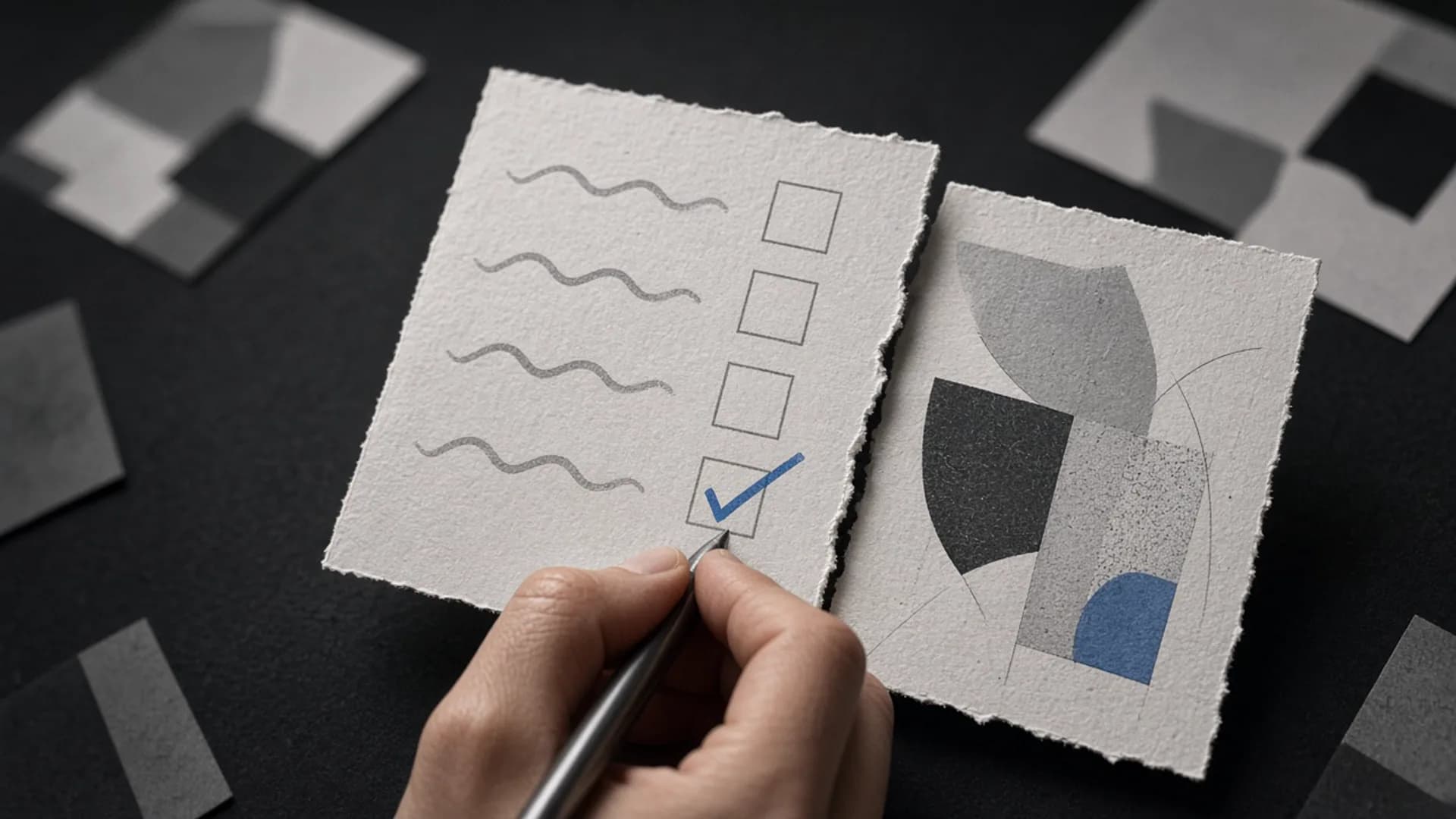
Where the pipeline usually breaks, in real life.
It breaks at the fact-checking step, almost always. It is the least fun, the one that doesn't show up in a portfolio, and the first to be skipped when the week gets tight. It is also the only one that protects against the mistake the customer notices.
It also breaks when approval belongs to everyone. A piece that needs three yeses becomes a piece that sits for two days and then gets approved on autopilot out of fatigue. One approver per piece solves it.
And it breaks when the agreed volume is bigger than the flow can handle. Then the review step is sacrificed silently — nobody announces it, it just stops happening. That is the beginning of the damage I describe in volume without review.
The process health question is this: in the busiest week of the month, which step disappears? That is your fragile step. And if the answer is “review,” your pipeline is decorative.
A note about tools, because the question always comes up.
None of this requires new software. You can run it in a spreadsheet, on a card board, in a shared text file. What matters is that it is outside people's heads and in the same place for everyone.
And that explains why switching models rarely solves a production problem. A new model improves the generation station — which usually wasn't the bottleneck anymore. The bottleneck is decision, selection and review, and no launch touches that. I develop that illusion in a new model is not a strategy.
Again: AI accelerates, you lead. A pipeline is the concrete form of that leadership. Without it, leading becomes a synonym for reviewing everything by hand, which doesn't scale and wears the owner down until they give up and release anything.
If I could leave a single swap, it would be this: stop collecting prompts and start collecting criteria.
Prompts age in weeks. Models change, interfaces change, the syntax that worked starts being ignored. Criteria don't age. “We don't publish deadlines the operation can't keep” applies to any tool, today and in three years.
A company that writes criteria accumulates an asset. A company that accumulates prompts accumulates a dead archive.
And there is a nice side effect. Written criteria improve human work too — the text someone writes by hand goes through the same filter, and gets better. A good pipeline isn't about AI. It is about the company knowing what it considers acceptable to sign.
A definition of done that fits on one sheet
- 1**It solves what was asked** — there is a sentence, written before generating, saying what this piece needs to make happen.
- 2**No unconfirmed facts** — price, deadline, name, address, product. If it couldn't be confirmed, it comes out of the piece, it doesn't go in as “probably.”
- 3**The implicit promise fits the real operation** — including on a bad Monday, with one person short on the team.
- 4**There is an approver with a name** — one person, not a department, not a WhatsApp group with eight members.
- 5**It went past a human eye after the last edit** — reviewing before the final tweak doesn't count; the mistake almost always gets in during the tweak.
A three-minute diagnosis
What sets a professional operation apart from a lucky one is repetition.
I have seen content generated at home, by a single person, with better quality than an agency's. And I have seen the same person, two months later, publishing something they shouldn't have because the week got tight and there was nothing between generation and the publish button.
It wasn't talent that changed. It was that there never was a structure, so the result was always at the mercy of the energy available that day. A pipeline is what makes the standard survive the bad day.
And there is a direct financial consequence, which is the subject of the real cost of AI in content: without steps and criteria, the savings AI generated in production come back multiplied as rework and corrections.
If building a process sounds too big, start with the cheapest thing: write your definition of done. Five lines. Stick it where the team can see it.
Then tell me how many pieces from last week would have passed it.
Want the workflow designed instead of improvised?
We build your AI content pipeline with you: steps, owners, the done criterion and the exact point where the human comes in.
Talk to the team