

Is AI only for big companies? That myth is expensive
Big companies use AI to scale what already works. Small businesses use AI to be in more places at once. Understand why size isn't the criterion.

Everyone fears AI for the wrong reason
The fear is usually about complexity and cost. The real risk is something else: continuing to do by hand what could already be structured.
"That's for big companies." It's the sentence we hear most when the subject is artificial intelligence. And it makes sense from the outside: the news talks about giant models, data teams, budgets that don't fit any neighborhood business.
The problem is that this reading confuses who builds AI with who uses AI. They're completely different things, with completely different costs.
The reversal that changes the conversation
Small businesses use AI to be present where there's nobody available: replying after hours, organizing what comes in, not losing messages.
The second case is more urgent than the first. Whoever has a big team can absorb disorganization. Whoever is two or three people can't.
In practice, the useful question isn't "is my business big enough for AI?". The question is: where does my operation depend on me being there to work? Every point where the answer is "it depends on me" is a candidate.
Where AI already helps, even in a small operation
- Replying to the first message after hours, without leaving the customer hanging.
- Qualifying who arrives: understanding what the person wants before you join the conversation.
- Organizing what's already been said, so you don't repeat a question the customer already answered.
- Turning meeting audio into a summary of what was agreed.
- Writing the first draft of a text you only need to review, not create.
- Translating what you say in technical terms into the way the customer understands.
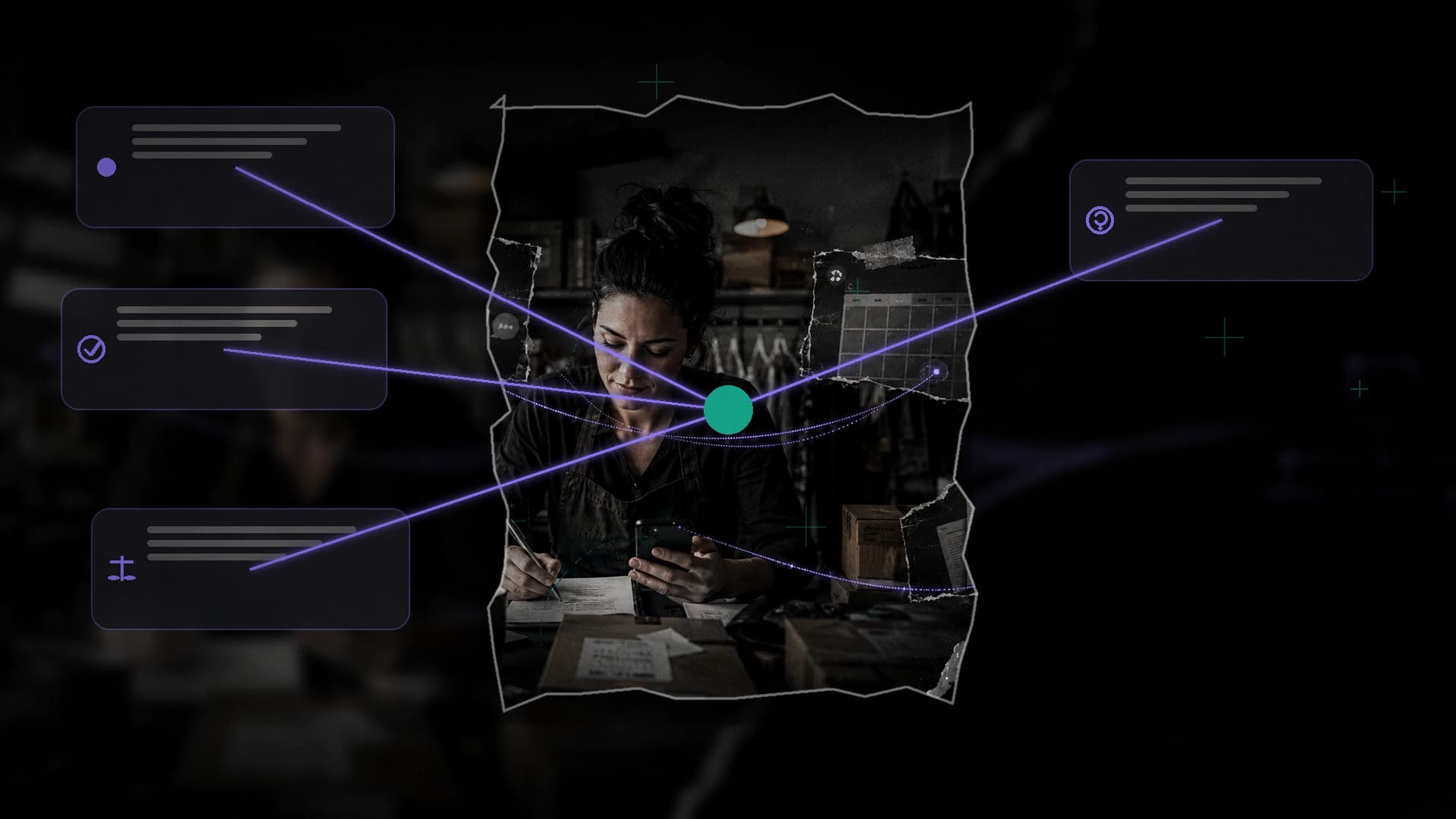
No item on that list requires hiring a data scientist, training your own model or understanding how the technology works inside. They all require just one thing: deciding which part of the operation you want to stop doing by hand.
“AI accelerates, you lead.”
That sentence isn't a showcase slogan, it's a rule of use. AI takes on volume, repetition and first drafts. The decision, the relationship and the judgment stay with you — and that's exactly what separates good automated customer service from an irritating robot.
What really holds small businesses back (it isn't size)
- Thinking you need to understand the technology before using it. You don't — you need to know what you want as a result.
- Starting with the hardest problem. Start with the most repetitive one: that's where the gain shows up fast.
- Expecting AI to get it right on its own. Without your business's context, it answers generically.
- Automating without a review point. Every automation needs someone looking at what came out.
- Treating it as a six-month project. A single bottleneck solved already changes the week.
Before automating anything
Example: "I want it to answer price questions right away, but never close a price without me seeing it". That second half is the one that protects your business — and it's the one almost everyone forgets to define.
The myth that AI is for big companies is expensive because it delays a simple decision. While it lasts, the business keeps losing messages at night, answering the same question for the twentieth time and spending the owner's time on things that didn't need the owner.
It isn't about size. It's about structure — and structure is exactly what's missing when the team is small.
Want to see where AI fits in your business?
We look at your operation, point out the spots that depend on you being there and show what can be structured first.
Talk to the team