

The WhatsApp that scaressales away — and the messagethat causes it
Your WhatsApp may be losing customers on the first message. See the patterns that push people away, what to put in their place and how to make sure the first reply always happens.

The sale isn't lost on price. It's lost on the first message.
The person made the effort to reach out. What they get in the first few seconds decides whether the conversation continues.
Getting to your WhatsApp is already the hard part. The person saw something, got interested, left what they were doing and came looking for you. At that point they are more willing to buy than they will be at any other moment.
And that's exactly where most businesses deliver the wrong message — not out of ill will, but because the first reply became an automatic item nobody has reread since it was set up.
The messages that push people away the most
- "Hello! We'll get back to you soon." It only says you aren't there. The person is left with no next step and goes looking for someone who answers.
- "Yes." / "We have it." A one-word reply sounds like they're bothering you.
- The seven-option numbered menu, when the person asked a specific question in text.
- "What's your name, phone, email and how did you hear about us?" A form disguised as a conversation, before any value is delivered.
- The two-minute voice message: they're on the bus, at work, without headphones.
- Silence until the next day, with "sorry for the delay" instead of the answer.
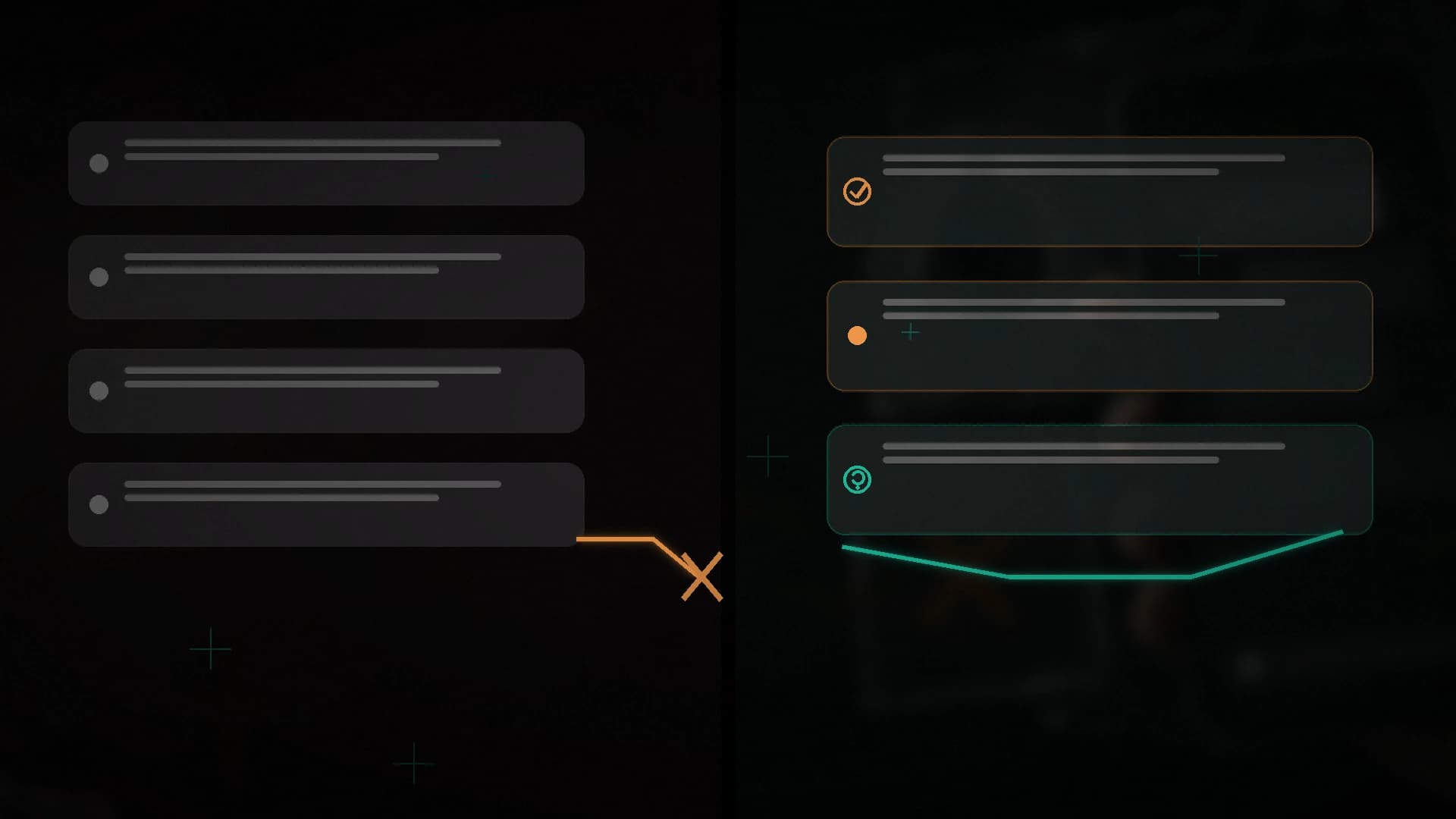
What these messages have in common isn't the tone. It's that none of them moves the conversation forward. They all hand back to the person the job of figuring out what to do next — and that's the moment they open the competitor's chat that's still open on their screen.
The most expensive mistake is the most discreet
The customer who arrived at 9 p.m. and received nothing never shows up in your report — because they never became a conversation. That's the leak nobody can measure by looking inward.
Fix the content of the first message
Three elements, nothing more
1. Confirms it arrived — the person needs to know they're talking to the right place.
2. Gives some useful information for free — even if it's how the service works or what the price depends on.
3. Asks a single question — the one that gets you what's missing to move forward.
Example: "Hi! This is [company]. We offer in-person sessions in Porto Alegre and also online, and the price depends on how many times a week. Do you prefer in-person or online?"
One question. Not three. An interrogation in the first message has the same effect as not replying.
Make sure it always happens
The perfect script loses to absence
That's why the first reply is the piece of the operation most worth structuring: it needs to be consistent, good and immediate regardless of who's available.
The limit has to be clear in the setup: the automation acknowledges, informs and asks. Closing the price, negotiating deadlines and handling out-of-the-ordinary cases still happen with a person.
A checklist to run today
- Send a message to your own business WhatsApp, as if you were a new customer.
- Read the automatic reply out loud. Does it inform anything or just say you're not there?
- Check whether there's a clear question at the end — and whether there's only one.
- Test it at 9 p.m. and on Sunday. Is the behavior the same?
- Check whether the link you share goes straight to the conversation, with no extra step.
- Ask an outsider to run the test and tell you where they got confused.
If you read our post about the website's first-screen mistakes, the pattern here is the same on another channel: the customer arrives willing, runs into friction and gives up in silence. Website and WhatsApp are the business's two front doors — and almost always both have the same problem, which is not having an obvious next step.
The yardstick for any message of yours
If the answer is no, the message isn't ready — no matter how polite it is.
Want the first reply to never fail?
With UzzApp your WhatsApp replies instantly, in your tone, with structure — and calls you when the conversation needs you.
Talk to the team