

In cinema, an image can lie.At your counter, it becomesa promise
Fiction has a contract with the audience: everyone knows it is made up. Ads don't. When a generated image shows something your operation doesn't deliver, the customer shows up demanding it — and they are right.
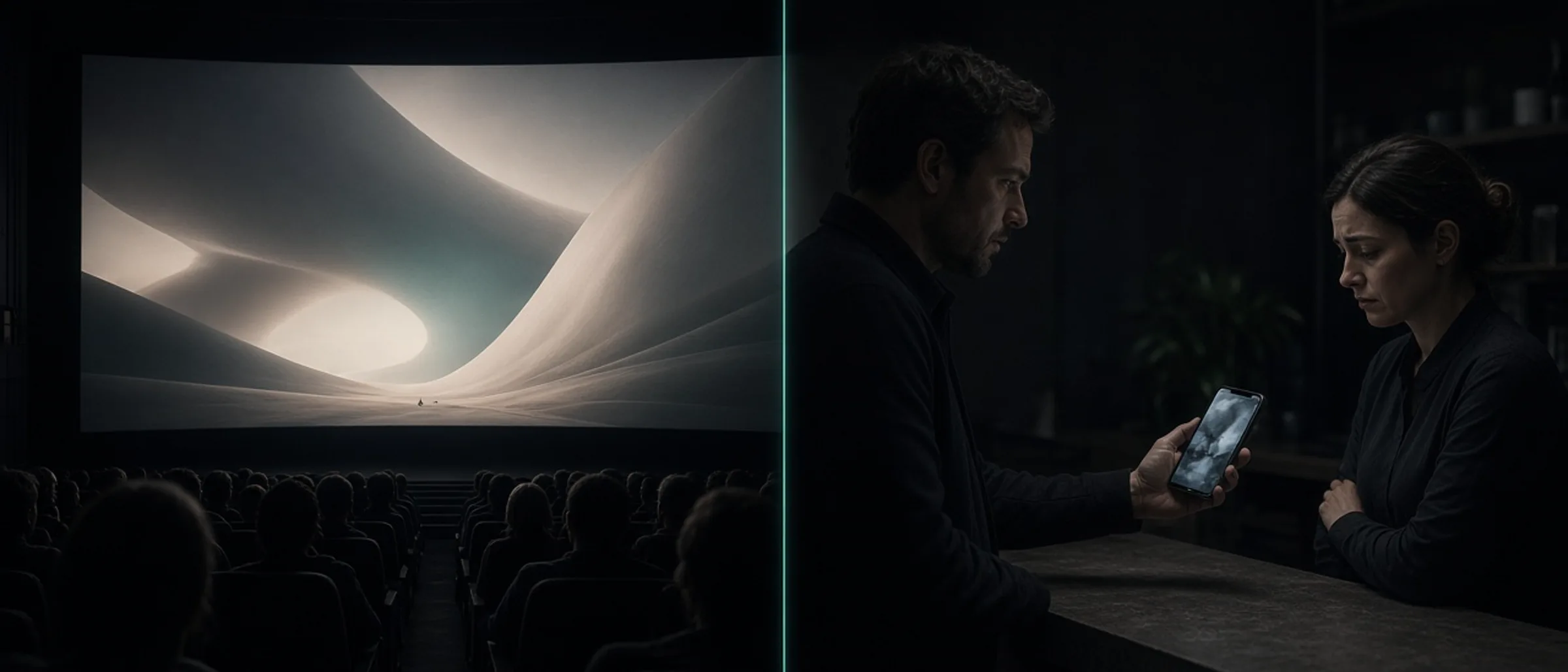
In cinema, an image can lie
At your counter, it becomes a promise. And customers collect on promises.
Cinema invented a very elegant agreement, and it is older than any imaging technology.
When you walk into the theater, you know it is a lie. The city doesn't exist, the building is a model, the rain is a hose, the actor didn't die. And nobody feels cheated — on the contrary, you paid for it. That is the genre contract: the audience accepts the invention because they know it is invention.
Fiction isn't dishonest. It is honest about being fiction.
Now look at an ad from a local business. What contract exists there? None, except the opposite one: people assume that what is in the image has something to do with what exists. That this is the product. That this is the store. That this color comes out of the box.
And that is the hole AI-generated images fall into most often. Not because they are fake — every advertising photo always had some artifice. Because they are convincing without being verifiable, and nobody told the customer.
Here is the method behind this series: we mapped public AI cinema and creative culture blogs to watch how people who work with generated images discuss the line between invention and information.
Declared bias: it is audiovisual, heavily weighted toward authorial work, and it is not small-business marketing. But that is exactly why the contrast is useful.
In that circuit, invention is the legitimate raw material. They can generate an animal that doesn't exist and be doing the right job, because the context is declared fiction. The hard discussion that world faces is a different one: labeling. What needs to be marked as generated? When does the viewer need to know?
They are wrestling with the question of the label, and that is fascinating — because it is exactly the question small-business ads should be asking and aren't.
The crucial difference is that, in cinema, the lie is the product. At your counter, the lie is a liability. Same technology, opposite contracts.
Where a generated image lies without anyone having lied.
It is almost never bad faith. It is filling in the gaps, which is what the model does by nature.
You ask for a photo of a dish from your restaurant. It returns a beautiful plate, with a side you don't serve and a portion bigger than yours. Nobody decided to deceive; the machine completed it with what is common.
You ask for an image of your store. It returns a wide, bright space with a shop window you don't have. The customer arrives and sees a different place.
You ask for a product photo. It improves the finish, evens out the stitching, perfects the symmetry. What reaches the customer's home is the real version, and now it looks worse than what they bought.
None of these cases is fraud. All of them produce the same practical result: the customer compared and felt cheated. And how they feel is what matters, because that is what turns into reviews, complaints and conversations with others.
This isn't completely new — advertising has always embellished. But two things changed in scale, and they weigh a lot.
The first is cost. Staging an unrealistic photo used to take a studio, a crew and hours. That cost worked as a brake, and also as a decision point: someone had to approve the budget for that shoot, and along the way someone asked whether it was honest.
Now there is no brake and no decision point. The impossible image costs the same as the faithful one, and comes out of the same click. Anyone in a hurry will pick the prettier one, because there is no reason not to.
The second is verifiability. A real photo had an anchor — someone was there, that thing existed in front of a lens. A generated image has no anchor at all, and the public already knows it.
That creates an unfair and growing side effect: your good, real photo becomes suspect. Whoever lies with images contaminates the credibility of those who don't — including yours.
The price, at the counter, is very concrete.
The customer arrives with the screenshot. They ask for what they saw. And now you are in a negotiation that started with you at a disadvantage, over an expectation you created yourself.
If you honor it, you lose margin. If you refuse, you lose the sale and gain someone telling the story to others. If you explain that “the image was just illustrative,” you lose credibility — and that sentence, said at the counter, sounds worse than it seemed in the planning meeting.
There is an extra cost almost nobody counts: the wear on whoever serves the customer. It is the front-line person who absorbs the frustration of a piece they didn't make and didn't approve. Do that a few times and the team loses confidence in its own marketing.
This is the same kind of leak I detail in the real cost of AI in content. Only here it is more direct: the piece cost nothing and charged at the register.
So it is worth separating things clearly, because this is not a text asking anyone to give up generated images. I use them.
There is a use that is safe and very good: when the image is clearly illustrative and states no fact. Abstract backgrounds, textures, conceptual scenes, an illustration of an idea in an article, an editorial composition nobody confuses with a record.
There is a use that is ambiguous and requires care: generic settings, generic people, usage situations. It can work, as long as it suggests nothing about your actual setup. A generic person smiling is not a problem. A generic person presented as your customer is.
And there is a use that, in my opinion, isn't worth the risk: images showing product, store, team, results or delivery. Those are facts. Facts get photographed.
The practical line is this: if the image answers “what is it like,” it needs to have been seen by a lens. If it answers “what are we talking about,” it can be generated.
How to write this down as a rule, in five minutes.
One sheet, three columns. Free to generate. Generate with care. Do not generate.
In the first, things that state nothing about your operation: backgrounds, textures, conceptual scenes, article illustrations.
In the second, the ambiguous ones, with a condition written next to them. For example: generic person, yes, but never captioned as one of our customers.
In the third, the facts: product, store, team, results, before and after, delivery. For those, real photos, even if shot on a phone and less pretty.
And then comes the part I consider the best marketing investment a small business can make this year, and it involves no AI at all: taking decent real photos. One afternoon with a phone in good light, a hundred photos of the real operation, saved in a folder.
With that library, the temptation of the invented image disappears on its own — because you already have the real one at hand, which is faster than generating.
Someone will ask whether you need to disclose that the image was generated.
My honest answer: when the image doesn't state a fact, no. Nobody needs a warning on an abstract background, and covering the piece in labels only creates noise.
When the image can be mistaken for a record of your operation, then a warning isn't enough — the right thing is not to use it. A label doesn't fix the expectation created; people look at the image before reading anything, and what sticks is the image.
I'm a bit skeptical of the idea that labeling solves it. It shifts to the consumer an interpretation job that should be ours, as curators.
The simplest rule I found is by function, not by technology: if someone can show up at the counter demanding what is in the image, the image has to be true. Regardless of how it was made.
That covers manipulated photos, old renders, stock images and generation — and it doesn't age with the next tool. It is the same principle as AI in marketing without humans.
There is one last layer I find the most interesting, and it is almost aesthetic.
Generated visuals have an accent. Light that is too perfect, exaggerated symmetry, textures clean in a way that doesn't exist. People are learning to recognize that accent very fast — faster than the marketing industry noticed.
And recognition comes with an automatic reading: “this isn't from here.” For a local business, which sells trust and closeness, that reading is terrible. It is the exact opposite of what the piece was trying to build.
Meanwhile, the so-so real photo — your store's light, your hand, the product the way it is — gained new value precisely because it is verifiable. Imperfection started to signal truth.
That is a beautiful inversion. For twenty years small businesses tried to look bigger than they were. Now the differentiator available is looking real — and that they always had for free.
The one-sheet rule: what can be generated
- 1**Free to generate** — backgrounds, textures, conceptual scenes, article illustrations. Nothing there states what your operation is like.
- 2**Generate with conditions** — generic people or settings, as long as they are never captioned as your customer, team or store.
- 3**Do not generate** — product, store, team, results, before and after, delivery. Those are facts, and facts get photographed.
- 4**The counter test** — if someone can show up demanding what is in the image, the image must be true, no matter how it was made.
- 5**Real library first** — one afternoon with a phone, good light and a hundred photos of the real operation kills the temptation better than any policy.
The two-line question
Fiction is honest because it warns you. Ads don't warn — so they need to be true.
That is the only rule I really defend in this text, and it isn't about AI. It applies to manipulated photos, to renders, to stock images, and it will apply to the next technology we haven't even seen yet.
What AI did was remove the brake. Before, lying with images was expensive and went through people; now it is free and instant. When the technical brake disappears, the brake has to be judgment — and judgment doesn't come with the subscription.
What I see working is modest: a short list of what can and can't be generated, a library of real photos, and the discipline to prefer what's true even when it is less pretty. You can set it up in an afternoon.
AI accelerates, you lead. In this series that showed up as command in human command in the age of AI, as structure in the pipeline is bigger than the prompt, as culture in what an AI festival reveals and as money in the real cost of AI in content.
Here it shows up as the simplest thing of all: at the counter, an image is a promise. And we keep our promises.
Want to separate what can be generated from what needs to be photographed?
We review the images you publish, build your one-sheet rule and organize the real photo library that replaces the temptation of the invented picture.
Talk to the team